
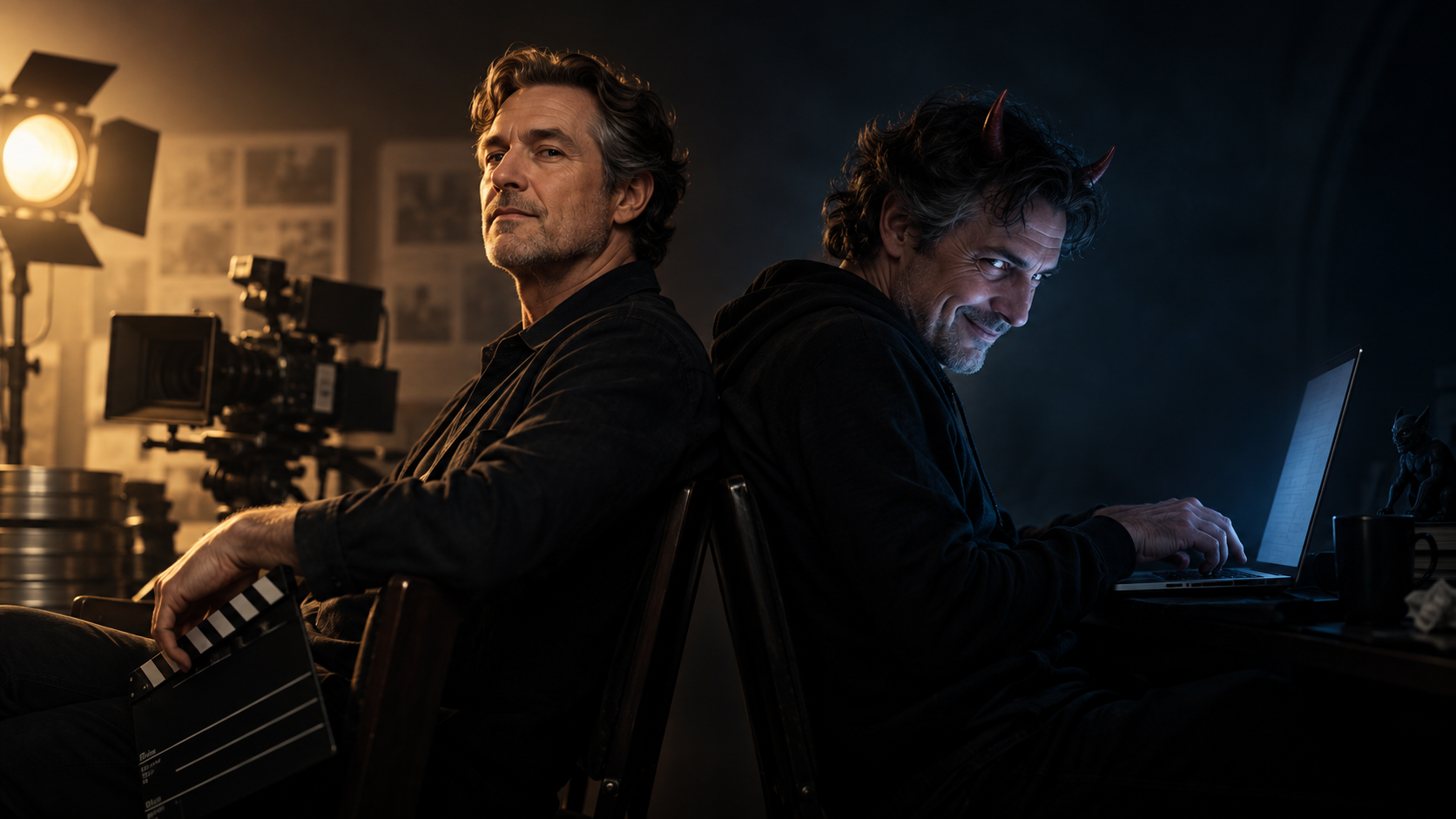
The backlash on AI and claiming everything is “AI Slop” is getting really gross.
I posted a video last week on linkedin and went to bed happy. That was the mistake.
The video is Denzel Washington, from a real movie, with new dialogue dubbed over him, explaining why AI slop isn’t what you think it is. It’s perfect. Somebody wrote it beautifully, cut it to the frame, and understood that the whole joke dies if the delivery is off by half a second. I laughed so hard I had to put the phone down and start it over.
So I wrote a caption I meant every word of. After fifteen years in television, making AI content is the most fun I’ve ever had. No approval. No pitching. No travel. No excuse. You just do it. You can put something up today and know by tonight whether it worked, and I have never seen that kind of speed for professional growth in my life.
Then I made coffee, opened LinkedIn, and met my new friends.
The first comment was two words, in capital letters. The second word was AI. The first word was a verb you should never type online if you want to be taken seriously. This was left by a man whose profile reads Director, Producer, Production Designer. Real name. Real headshot. Little verification badge next to it, because he is a verified professional, and he was verified when he did it. On LinkedIn. The website that exists for the sole purpose of letting strangers decide whether to hire you.
I replied with one word.
“Classy.”
Forty-four people have now seen that exchange. I hope one of them signs his checks.
Next came a gentleman who informed me the video was stolen art, since somebody took existing footage and put new words in the mouth.
I asked him if he’d ever heard of collage.
I stopped there, which I consider enormous personal growth, because the full version takes a while. Sampling. Parody. The Dadaists and their scissors in 1916. Warhol and a soup can that Campbell’s did not design for him. Every trailer house in this town cutting a spot to a song they didn’t write over footage they didn’t shoot for an audience that has never once filed a complaint. We have been remixing each other since one cave guy painted an animal a different cave guy killed, and nobody has apologized yet.
Then a motion graphics artist, whose headline has the little red no-symbol wrapped around the letters A and I like a garlic braid, showed up with a gif. Billy Madison. The one where the moderator calmly informs a grown man that everyone in the room is now dumber for having listened to him.
He had no idea who he was dealing with.
I have been preparing for this exact moment my entire life. I sent back The Dude. Feet up, sunglasses on, that’s just like your opinion, man. Then I sat there with my coffee, lit up like a pinball machine, absolutely praying he’d go again. No meme is too obscure. No meme is too small. I have a folder, I have search terms, I will find the frame. Let’s go!
One person laughed at it. I’m counting that as a win.
Somebody else wrote, in full, “No he didn’t.”
So I had to ask. “No he didn’t, or Oh no he didn’t?”
I never got an answer.
And then, buried under all of it, a man named Rupert wrote the only comment that actually engaged with the thing. Before you freeze-frame this hunting for a flaw in the beard stubble, he said, consider what makes the clip work: the writing, the drama, the rhythm and cadence of the speech. Every creative decision in it is completely independent of the visuals.
Yes. Thank you. That’s the entire argument.
I wrote back that I laughed, I cried, I poured a little of my drink on the ground for the great ones, and not once in the whole thing did I stop to announce that it was AI. I just enjoyed the ride. Which, last I checked, is the only thing anybody has ever asked of a piece of film.
The kids would like to go back to 1978
Now, the part that surprised me. I assumed the anger was all coming from people my age, men with lab invoices buried somewhere in their bones. Wrong.
A whole lot of it is coming from twenty-two year olds who would like to return to 1978, buy a Polaroid, and prove to you that they can take a good photograph by standing in a parking lot waiting three minutes for it to appear. They don’t just tolerate the wait. They want the wait. The wait is the point. The wait, I regret to report, is also content.
A friend in our filmmakers group was telling us about his son, who is deeply anti-AI and shot his whole project on film. The correct way. The honorable way. They wrapped. They developed. And most of it came back out of focus. Nobody knew, because nobody could know, because that’s the deal. You find out at the end, in a room, together, with your hands over your mouth.
So they reshot it. On film. Again.
I had to mute myself, I was laughing so hard. Not at the kid, I love the kid, the kid has convictions. It’s that he has zero tolerance for AI and an absolutely heroic tolerance for pain. That is an entire generation in one story.
Now, about that wait. I have done the wait.
In 1988 I came home from a trip through Europe with twenty rolls of film in my bag. Twenty. I handed them over like a kid bringing home a stray dog, all hope, no plan. My father did the math out loud. I would love to tell you what he said, but he is a lovely man.
And when those rolls finally came back, a solid chunk of them were garbage. Thumbs. Blurs. A stranger’s elbow. A cathedral I would have sworn on my life I framed perfectly. There is no undo on a cathedral you have already flown home from.
The barrier to entry was never a young artist’s willingness to suffer for her craft. It was my dad’s wallet. And my dad had strong feelings about his wallet.
For the record, I did it the long way. I studied photography at in high school and then at Syracuse. I even got a $72K scholarship for my photography. I had a darkroom in my bathroom, which is something you can do if you have a patient family and no functioning sense of smell. I then married a man who shot for his college paper and also had a darkroom in his bathroom. We are that couple. There is nothing to be done about us now.
I also own a 16mm editing machine. A neighbor put it out on the curb, and I could not stand to watch it get tossed into a truck by somebody who didn’t know what it was, so I walked it into my house, where it sits to this day, beloved and roughly the size of a pony.
I have touched it four times.
The receipts, since we’re apparently doing receipts
Fifteen years producing television. The Real World. Road Rules. A very long list of shows you have never heard of, and I am not going to insult you by pretending otherwise.
I drove tapes to edit bays. In a car. In traffic. Because footage in 1999 did not email itself, and if I got in a wreck, the show didn’t air.
I logged interviews by hand, timecode by timecode, on paper, for hours, hunting for the four usable seconds buried inside a ninety minute sit-down with a man who would not stop talking about his boat.
I flew to something like forty states to meet stringer crews. I once crossed the entire country for one interview that today would be a link in an email.
And I have digitized at real time speed, which the young people should really hear about, since we’re romanticizing hardship. It means sitting in a dark room watching a bar crawl across a screen for exactly as long as the tape is long. Eating a sandwich. Staring into the middle distance. Quietly reviewing the chain of decisions that brought you to this room.
Grease pencil. Splicing tape. I still own Super 8 cameras. I cut film on a Super 8 Elmo. Waiting on dailies from the lab like a war bride at a window. Couriering Beta SP tapes across town and praying. Paying an optical house real American money for one dissolve.
Every one of those got replaced by something faster, and every single time, somebody stood up and announced that the work was about to lose its soul. The work did not lose its soul. The work got made by more people, which I have come to suspect was the actual complaint.
The wall that isn’t there anymore
For my entire career, the thing standing between an idea and a finished piece was never talent. It was money, time, location, and access. Four bricks tall. I spent twenty years on the wrong side of it, holding folders of shows that were waiting on an investor, a name, a permit, or one open window in somebody else’s calendar. Two of mine got optioned and then sat there, beautifully and expensively, going nowhere, while I waited out the contract writing more of them.
That wall is gone and I am still a little dizzy about it. I started an account called Vote the Plot on Instagram and TikTok for no reason except that I wanted to, and now I make things at eleven at night in my own kitchen with nobody’s permission and nobody’s notes.
What the room actually sounds like on a Monday
I’m in an AI filmmakers group run by my friend Tim Street, who runs one for vertical filmmakers too, and we meet Mondays and Thursdays. These are working professionals. Credits and scars.
Do you know what we spent this week talking about? That production in Los Angeles looks like it’s up.
Not one person cheered for the industry to die. Nobody has ever cheered for that, in any room I have ever sat in, ever. We were glad for our friends still on crews, because they are our friends, and because most of us came off those crews and know exactly what a slow year feels like in a house with a mortgage. Then we went around and showed each other what we were building, and I logged off feeling the way I felt in 2009, when you could post that you were sitting in some coffee shop and a person who would change your life would walk over, because they happened to be sitting there too.
It’s the wild west out here. It is not full of people hunting for shortcuts. It’s full of people who did the long version for twenty years and are finally making the thing they got told no about.
So here’s my theory, and I offer it with love
I’ve been building online community since 2006. That’s the year I launched BakeSpace, a food social network, back when saying “food social network” out loud to an investor made him tilt his head like a dog hearing a vacuum. A hundred and thirty thousand recipes later, I have watched grown adults go to war over buttercream, over whether a brownie may legally contain a nut, over the correct internal temperature of a bird that is already deceased.
I have seen everything the internet has. Twice.
I had not seen this. And to be clear, the disagreement is fine. I’ll argue all day about what makes a thing good and buy the second round. It’s the cursing. Professionals, in public, on the one platform built entirely around their own reputations, while every person who might hire them scrolls past at lunch. Yes, I’ll admit, I cuss in video calls with friends… it’s not beneath me to get saucy. But in text, forever. That’s not a hill I want to die on.
The rage isn’t really about the tool. It’s about the twenty years.
Every one of those men did it the hard way, same as I did, and nobody ever threw us a parade for it. We ate the lab fees. We drove the tapes. We wrote the thing and waited, and called the guy and waited, and got the no, and wrote another one. We built entire careers out of asking permission, permission mostly didn’t come, and now here is a machine handing it out for free to anybody with a laptop and a decent idea.
That does something to a person. I felt it myself, for about an afternoon, standing in my own house next to a flatbed I rescued off a curb because I couldn’t stand to watch the past get thrown away.
Then I thought about the girl with the darkroom in her bathroom and the twenty rolls in her bag, and what she would have done with this.
She would have lost her entire mind. She’d have made forty terrible things and six good ones, and she would not have asked one single adult first.
My father developed those rolls, by the way. He complained the whole time and then he did it, because he was a photographer, and a photographer does not let twenty rolls sit in a bag. Since I was a kid he told me about the time he and my mom photographed Mother Teresa in Michigan and they couldn’t afford to get the film developed (and never did). He wasn’t going to let me have those regrets (even if my photos were of buildings that are still here today). My dad is the one who put my first Nikon in my hands. He taught me what I was actually looking at through it.
Not every kid gets a father with a darkroom and strong opinions about grain. That’s what I keep thinking about when somebody tells a twenty-two year old to go earn it the hard way first. The hard way always had a cover charge, and mine got paid by my dad.
Nobody has to pay it now. That’s the whole thing I’ve been trying to say for two thousand words while grown men scream at me in capital letters.
So call it slop. Call it cheating. Call it the death of cinema, put it on a shirt, I’ll buy one and wear it to the Monday call. (Those guys would love it!) I’ll be in my kitchen at eleven at night in my reading glasses, eating cereal standing up, building a world that used to require a studio, a permit, an investor, a name attached, and eighteen months of somebody else’s calendar. And I’ll post it before the cereal goes soft.
Meanwhile, my husband shoots Canon. I shoot Nikon. We have been fighting about this since before we were married and we will be fighting about it in the nursing home, where I will still be right. That fight is fun. That fight is what a disagreement between two people who love the same thing is supposed to sound like. Nobody has ever called me a thief over it. Nobody has ever sent me a gif about it.
So come find me. Vote the Plot, on Instagram and TikTok. Or the comment section, where I’ll be sitting with a full folder and a great deal of free time.
Nikon, obviously!
Want to connect? Follow me on linkedin or find me at Pepajmedia.com.